

The best charcoal grills for steak are the Weber Original Kettle Premium 22-Inch for most cooks, the Char-Griller AKORN 20-Inch Kamado for the hardest sear, and the Weber Jumbo Joe Premium if your patio is small. All three reach sear heat, recover fast when the lid opens, and let you shrink the fire away from thick cuts.
A grill built for steak is not the same animal as a grill built for burgers. A 2-inch ribeye needs a fire you can push away from the food, a grate heavy enough to hold temperature, and enough cooking area to lay several steaks down at once without crowding the edges. That is the standard we ranked these ten against.
We spent weeks putting identical cuts through these grills, watching how each one recovered after the lid came off, how the grates behaved with fat dripping, and whether we could hold a gentle finish after a hard sear. The full protocol is below, but the short version: the mid-size kettle wins on control, the kamado wins on raw sear heat, and the budget grills in this list win on surface area per dollar. If your main event is a single thick cut on a Thursday night, the kettle is the one to buy. If you cook for eight on a Sunday, jump to the larger barrel and offset options later in the guide.
If your cooking happens on a patio, a balcony, or a campsite rather than a full backyard, we also rounded up the best portable camping grills for comparison. Two of the grills below show up in both conversations, which is a good sign for the cook who does both.
Table of Contents
- Top 3 Picks for Best Charcoal Grills for Steak (October 2026)
- Best Charcoal Grills for Steak at a Glance in 2026
- How We Tested These Grills for Steak
- How to Sear Steak on a Charcoal Grill: 3-3-3 Rule and Reverse Sear
- 1. Weber Original Kettle Premium 22-Inch: Best Overall for Steak
- 2. Royal Gourmet CC1830S Offset Smoker Grill: Best Budget Two-Zone Setup
- 3. Royal Gourmet CC1830 28-Inch Barrel: Best for Travel for Family Steaks
- 4. Weber Jumbo Joe Premium: Best for Small Patios and Apartments
- 5. Char-Griller AKORN 20-Inch Kamado: Best for High-Heat Sear
- 6. Royal Gourmet CD2030AN 30-Inch Deluxe: Best for Large Groups
- 7. Kamado Joe Joe Jr 13.5-Inch: Best Portable Kamado for Steak
- 8. DNKMOR 500 Square Inch Barrel: Best for a First Grill
- 9. Oklahoma Joe’s Longhorn Reverse Flow Offset: Best for Big Cuts and Groups
- 10. IronMaster Mini Cast Iron Hibachi: Budget Pick and One-Person Cooking
- What to Look for in a Charcoal Grill Built for Steak
- Lump Charcoal vs. Briquettes for Steak
- Frequently Asked Questions
- Final Verdict: Which Charcoal Grill for Steak Wins
Top 3 Picks for Best Charcoal Grills for Steak (October 2026)
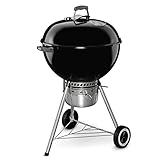
Weber Original Kettle Premium 22
- Round 22-inch grate you can spin between zones
- One-Touch ash catcher
- Porcelain-enamel bowl holds sear heat

Char-Griller AKORN 20-Inch Kamado
- Cooks 200F to 700F
- Triple-wall insulated steel
- Cast iron grates with removable center

Weber Jumbo Joe Premium
- Same Weber materials in a 22-inch frame
- Holds up to 13 burgers
- Aluminum ash catcher
The Weber Original Kettle takes the top slot because it is the only grill here that solves the two-zone problem without any mechanism at all: the grate is round, so you rotate it to move steaks from the hot side to the cool side without tongs. The AKORN earns its spot on pure sear output, holding 600F and beyond on cast iron grates in a body that conserves fuel. The Jumbo Joe brings the same Weber airflow control to a 22-inch frame that fits beside a house rather than in the middle of a yard.
Best Charcoal Grills for Steak at a Glance in 2026
| Product | Specifications | Action |
|---|---|---|
| Weber Original Kettle Premium 22-Inch |
|
Check Latest Price |
 Royal Gourmet CC1830S Offset Smoker Grill Royal Gourmet CC1830S Offset Smoker Grill |
|
Check Latest Price |
 Royal Gourmet CC1830 28-Inch Barrel Royal Gourmet CC1830 28-Inch Barrel |
|
Check Latest Price |
| Weber Jumbo Joe Premium |
|
Check Latest Price |
| Char-Griller AKORN 20-Inch Kamado |
|
Check Latest Price |
 Royal Gourmet CD2030AN 30-Inch Deluxe Royal Gourmet CD2030AN 30-Inch Deluxe |
|
Check Latest Price |
 Kamado Joe Joe Jr 13.5-Inch Kamado Joe Joe Jr 13.5-Inch |
|
Check Latest Price |
 DNKMOR 500 Square Inch Barrel Grill DNKMOR 500 Square Inch Barrel Grill |
|
Check Latest Price |
 Oklahoma Joe’s Longhorn Reverse Flow Offset Oklahoma Joe’s Longhorn Reverse Flow Offset |
|
Check Latest Price |
 IronMaster Mini Cast Iron Hibachi IronMaster Mini Cast Iron Hibachi |
|
Check Latest Price |
How We Tested These Grills for Steak
We did not test these grills on burgers. Every grill in this list was run through the same five-part steak protocol, because burger performance and steak performance disagree often enough that ranking on burgers would send you to the wrong grill.
Preheat and recovery. We lit a chimney, dumped it in, closed both vents, and waited for white ash. Then we logged how long each grill took to get back to cooking temperature after opening the lid and removing a steak.
Two-zone control. With a 2-inch ribeye in place, we dropped the charcoal away from the food using whatever the grill offers: vents, an adjustable pan, a removable grate section, or simple fire management by hand. A grill that cannot do this scores poorly no matter how high it peaks.
Crust and grate behavior. We ran a fatty strip steak over the direct zone and watched for flare-ups, sticking, and crust release. This is where thin nickel-plated wire grates and heavy cast iron grates separate from each other in a way no specification sheet shows.
Recovery after the sear. After the crust was set, we added the lid back on and checked whether the grill could hold a gentle finish without either scorching the fat cap or stalling.
Cleanup. We opened every ash system, emptied it, and noted how much ash ended up on the shelf, the ground, and the cook’s hands. Steak cooks leave more grease behind than burger cooks, so a grate that sheds grease into an inaccessible trough becomes a real problem.
Two habits came out of this that changed how we cook on every grill in the list. Blow the coals dry with a fan right before the steak goes down, because loose ash on the grate is what strips a crust. And open the lid less than you think you need to, because most of these grills lose more heat in five seconds of cold air than they lose in ten minutes of cooking.
How to Sear Steak on a Charcoal Grill: 3-3-3 Rule and Reverse Sear
The 3-3-3 rule is three minutes per side, three minutes per side again, and three minutes of rest. It is a good skeleton for a 1.5 to 2-inch steak over a live charcoal fire, and every grill here can deliver it.
A reverse sear fits charcoal better than it fits gas. Cook the steak on the cool side of the grate with the lid on until the center approaches your pull temperature, then move it over the direct zone for a short sear on each side. Because the steak starts cold and ends hot, you spend far less time over the fire, and the crust forms in the last ninety seconds rather than scorching during a long cook. On r/grilling the consensus is the same: preheat the grill as hot as it will go, flip often, then move to indirect.
On temperature, aim for 450F to 500F at the grate surface before the steak goes down. Below 400 you will get a brown exterior without the deep brown crust that people are chasing, and above 500 the fat cap starts rendering before the center catches up. If you want a hard sear, enthusiasts on r/BBQ lay the steak directly on the coal bed for under a minute and then move it to the grate.
Pat the steak dry, salt it, and let it sit at room temperature for 30 to 45 minutes.
Light a chimney and dump the coals. Wait for the last ember to turn grey and ash over.
Spread the coals to one side. Banked heat on a single side gives you both zones.
Place the steak on the cool side, lid closed, and cook to within about 10 degrees of your target.
Move the steak to the direct side for 90 to 120 seconds per side, watching for flare-ups and pulling early.
Rest for 3 to 5 minutes. Carryover cooking keeps moving the center temperature after you lift it.
Whether you oil the steak or the grate matters less than most people think. A very light coat on the grate reduces sticking; oiling the steak itself mostly seasons the crust rather than preventing sticking. If you are using a fine mesh pan for drippings, preheat it with the grill so the fat renders into hot oil instead of tearing.
1. Weber Original Kettle Premium 22-Inch: Best Overall for Steak
Weber® Original Kettle Premium Charcoal Grill, 22-Inch, Black
22-inch porcelain-enamel kettle
Built-in lid thermometer
One-Touch ash catcher
32.3 lb
Pros
- Round grate rotates between hot and cool zones
- Recovers quickly after the lid opens
- One-Touch ash catcher empties in seconds
- 12904 owners have rated it
Cons
- Picture-only assembly instructions
- Lid thermometer reads slightly high
- Grate sits low at 27 inches
This is the grill we keep coming back to. The cooking area is a single 22-inch round grate in a porcelain-enamel bowl, and the enamel is what makes it a steak grill rather than a general-purpose one: it reflects radiant heat back into the fire, so the coal bed stays aggressive long after the fuel is in.
The round grate is the underrated feature. When the fire burns down on one side, you rotate the grate itself and the steaks move to the cooler half without tongs, without stacking, and without dropping anything. Users on WeberKettleClub forums point to exactly this when explaining why a round kettle handles thick cuts better than it should for its simplicity.
Vent control is the whole game on this grill, and Weber’s rust-resistant aluminum damper is the reason it holds a steady temperature. Close the lid vent fully and leave the bowl vent cracked for indirect cooking; open both for a hard sear. It is a two-lever system, which sounds crude until you have cooked on a grill with a digital controller that overshoots every time.
For a ribeye, the pattern that works best is a hard sear over the direct zone first, then spinning the grate a quarter turn so the steak finishes over cooler coals with the lid on. Many owners report six-plus years of solid use, and the 10 year limited warranty backs that up.
Why it earns the top spot
The grill that handles a 2-inch cut without burning the outside is the one that can both sear hot and finish gentle, and this kettle does both with nothing but air control. The ash catcher empties in seconds after a fatty steak session, which matters more than it sounds once you have cleaned ash out of a welded tray.
Where it falls short
Two real compromises. The grate sits at 27 inches, so a long sear session has you bent over it, and the built-in lid thermometer reads slightly hotter than an external probe, which will pull a steak early if you trust it. Both are tolerable; the height is the one people notice after an hour of ribeye.
2. Royal Gourmet CC1830S Offset Smoker Grill: Best Budget Two-Zone Setup
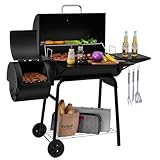
Royal Gourmet CC1830S BBQ Charcoal Grill and Offset Smoker, Outdoor Camping
823 sq in total cooking surface
197 sq in offset chamber
Two-level adjustable charcoal pan
45.2 lb
Pros
- 823 sq in of surface across grates and chamber
- Adjustable charcoal pan gives two-zone control
- Offset chamber adds smoke flavor in one unit
- Front and side tables for prep
Cons
- Thin steel burns through fuel faster
- Bottom openings limit fine control
- Assembly steps can strip screws if forced
This grill’s pitch for steak people is the adjustable charcoal pan, and it works the way the marketing claims: two levels, so you can drop the coals away from a thick cut and bring them back up for the sear without moving the food or the grate.
Total usable surface is 823 square inches across the 475 square inch porcelain-enamel wire grates, a 151 square inch warming rack, and the 197 square inch offset chamber. That is the largest number on this list for a cart-style grill, and it means four thick steaks cook in one pass rather than two rounds.
The wire grates are where the steak experience softens. Thin porcelain-enameled steel wire radiates less heat than cast iron, so recovery after you move a steak around is slower, and a fatty strip can flare through the gaps and scorch the crust. Keep the direct side over a smaller pile of lump charcoal and the problem largely disappears.
Buyers consistently report easy assembly and steady heat, along with the same caveat: thin sheet metal means more charcoal consumption and faster surface rust than a heavier grill. The side access door is genuinely useful for a steak cook because you can add coals without cracking the lid.
Who this grill suits
Buy this one if you want grill and smoker in a single box, you cook for a crowd, and you would rather learn charcoal control on an adjustable pan than on vents alone. The two-level tray is the closest thing to a real two-zone system you will find in a cart grill at this weight.
Where it falls short
The construction is the limit. Thin steel has almost no insulation, so it drinks fuel during a long ribeye cook, and bottom vent openings make precise temperature holding harder than the pan adjustment suggests. Long-term owners also flag screw stripping during assembly, so assemble it with the tools it came with.
3. Royal Gourmet CC1830 28-Inch Barrel: Best for Travel for Family Steaks
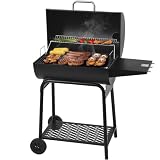
Royal Gourmet CC1830 28 Inch Barrel Charcoal Grill, Side Table
626 sq in cooking area
Chrome-plated warming rack
Lid thermometer
34.2 lb
Pros
- 626 sq in of cooking area for a compact footprint
- Two-level adjustable charcoal pan
- Warming rack adds a second tier
- Side shelf with tool hooks for prep
Cons
- Assembly is basically a two-person job
- Thin metal some owners expect to last only a couple of years
- Does not conserve coals well
The barrel layout puts the grate high and the fire low, which is exactly the geometry you want for a first serious steak cook. The 22.6-inch depth leaves room for a full-size chimney and gives the coals space to spread into an even bed rather than stacking under a small fire.
Cooking area is 626 square inches across porcelain-enameled steel wire grates, plus a 151 square inch chrome-plated warming rack. In practice that is four to five 1.5-inch steaks with breathing room on each side, which is the number most families actually cook.
The adjustable charcoal pan is the feature that separates this from a basic barrel. Two levels means you can drop the fire away from a thick cut for the last few minutes, which is the entire trick to reverse searing on a barrel grill. The closeable side air vent and adjustable smoke stack handle the rest.
Owners generally feel the grill delivers more than they expected for the money, and customer service has replaced a bent grate quickly in at least one documented case. The recurring note is that picture-heavy assembly instructions make this a two-person job.
Why it beats the cheaper grills for steak
Two things. The adjustable pan gives a beginner a physical way to create two zones, and the high grate keeps your forearms out of the heat during a long sear. Both matter more for steak than any specification on the box.
Where it falls short
Thin sheet metal is the honest weakness, and some reviewers expect a couple of years rather than a decade of service. It also does not conserve coals, so a long cook costs more fuel than it should. If you plan to keep a grill for ten years, look up the size class.
4. Weber Jumbo Joe Premium: Best for Small Patios and Apartments
Weber® Jumbo Joe Premium Compact Charcoal Grill, 22‑Inch, Black
363 sq in cooking area
Porcelain-enamel bowl and lid
All-weather wheels
10 year warranty
Pros
- Same Weber materials and dampers as the full-size kettle
- Easy to move and store
- Aluminum ash catcher empties fast
- Holds up to 13 burgers
Cons
- Limited capacity for large gatherings
- Single grate level with no warming shelf
- Porcelain enamel chips if knocked
The Jumbo Joe Premium is a Weber kettle shrunk to a 22-inch frame and mounted on wheels, and for a cookout of two to four people it does everything the bigger kettle does. The porcelain-enamel bowl and lid, the rust-resistant aluminum dampers, the 10 year limited warranty: it is the same package.
Cooking area is 363 square inches with a single durable-plated steel grate and no warming shelf. That is roughly two to three thick steaks at a time with room to move them around, which covers most weeknight cooking and most small patios.
The one design decision that matters for steak is that the grates sit closer to the coals than on a full-size kettle, which is a genuine benefit: faster recovery and a hotter direct zone for the sear. The trade is that you lose the round-grate rotation trick in a useful size, because 363 square inches is not much room to spin.
Users treat this as the small-yard or balcony grill and report strong heat retention and painless ash cleanup. The enamel does need care around the edges, since a chip in the finish is where rust starts.
Why it works for steak
Weber airflow control in a footprint you can wheel against a wall. If your outdoor cooking space is a patio rather than a yard, this is the grill that will not be in the way, and the ash catcher means cleanup happens in under a minute.
Where it falls short
Capacity is the honest answer. If you are cooking a porterhouse plus sides for six, this is the wrong tool. There is also no warming rack, so anything waiting to be served has to sit somewhere else.
5. Char-Griller AKORN 20-Inch Kamado: Best for High-Heat Sear
Char-Griller AKORN 20-Inch Kamado Charcoal Grill and Smoker, Triple-Wall Insulated Steel with Cast Iron Grates, Warming Rack and EasyDump Ash Pan, 445 Sq. In. Cooking Area, Graphite
200F to 700F range
445 sq in cooking area
Cast iron grates
EasyDump ash pan
97 lb
Pros
- Reaches and holds searing heat on cast iron grates
- Triple-wall insulation conserves fuel
- Holds smoking temperatures for hours
- Easier to move than a ceramic kamado
Cons
- Steel body and paint need regular oiling and a cover
- Lid thermometer is not accurate
- Vent positions are poorly explained in the manual
This is the grill that sears hardest, and the reason is cast iron on a heavily insulated body. The AKORN’s specified cooking range runs from 200F to 700F, and owners regularly report cooking steaks and chicken at 600F with the lid closed.
Cooking area is 445 square inches on a 20-inch diameter, with thick cast iron grates and a removable center section that lets you add charcoal without lifting the whole grate. That removable center is a small design decision with an outsized effect on a long cook: you can build fuel as the steak rests.
Triple-wall insulated steel holds heat and conserves fuel far better than any open kettle here, which means a reverse sear works unusually well here: bring the temperature down for the indirect phase, then push both dampers open to slam the grate hot again. The indexed dual dampers make that a repeatable adjustment rather than a guess.
Experienced owners describe it as delivering most of what a ceramic kamado delivers at a fraction of the cost, and the folding side shelves plus locking casters make it more manageable than a 97-pound unit should be. It still weighs 97 pounds.
Why steak cooks love it
The cast iron grates radiate heat into the steak instead of just conducting it, which is what produces a dark, hard-edged crust. Combined with insulation that holds 600F, it gives you the sear temperatures that thin wire grates in this list cannot reach.
Where it falls short
The steel shell and paint will rust without a cover and regular oiling, and the supplied lid thermometer is inaccurate enough that most owners buy a separate probe. The vent control also has a learning curve that the manual does not help with.
6. Royal Gourmet CD2030AN 30-Inch Deluxe: Best for Large Groups
Royal Gourmet CD2030AN Deluxe 30-Inch Charcoal Grill, Collapsible Tables
719 sq in total cooking area
Crank-handle charcoal tray
Front access door
73.2 lb
Pros
- Largest cooking area among the cart grills here
- Crank handle raises and lowers the charcoal tray
- Front access door cuts heat loss when adding fuel
- Collapsible side tables for storage
Cons
- Thin metal and low-grade hardware
- Charcoal tray can warp with heavy lump use
- Directions thin enough to cause assembly errors
At 719 square inches of total cooking space across 498 square inches of porcelain-enamel wire grates and a 221 square inch warming rack, this is the grill to buy when eight people are eating steak at once. It lays a whole batch down in a single cook, which is the entire point.
The crank-handle charcoal tray is the standout feature. It holds up to 7.5 pounds of charcoal and raises and lowers on a crank, so moving from a hard sear to a gentle finish is a mechanical action rather than shovel work. Long-term owners report it holds temperature well.
Opinion splits on this grill by unit and by expectation. Some owners have run it for four years and like the size and even heat. Others report stripped screws, dented parts on arrival, and a tray that warped within a season of heavy lump charcoal use.
The front charcoal access door is a real convenience for steak cooking, since adding fuel does not mean lifting the lid and dumping heat. The side damper and lid-mounted stack handle the rest of the airflow.
When it earns its space
Group cooks and anyone who wants a full ribeye roast plus four steaks going at the same time. The crank tray and the sheer grate area let one grill handle a whole meal without a second round.
Where it falls short
Thin metal means little insulation and more charcoal per cook, and the 1 year warranty is the shortest on this list. Owners consistently recommend sealing the firebox, and the tray warping issue is the one to watch if you use a lot of lump charcoal.
7. Kamado Joe Joe Jr 13.5-Inch: Best Portable Kamado for Steak
Kamado Joe Joe Jr 13.5-inch Portable Ceramic Charcoal Grill with Grill Stand, Stainless Steel Cooking Grate, Heat Deflectors and Ash Tool in Red, Model KJ13RH
150 sq in cooking area
Thick-walled ceramic shell
304 stainless grate
Two cooking levels
Pros
- Ceramic shell holds heat and uses very little charcoal
- Reaches searing temperatures above 500F
- Heat deflector plates let you run true indirect heat
- Lifetime warranty on the ceramic
Cons
- At 75.6 pounds it is heavy for its size
- 150 sq in suits only two to three people
- Without added wood the smoke flavor is subtle
The Joe Jr is the most efficient grill on this list, and efficiency matters when you are searing on a small surface. Thick-walled ceramic holds heat so well that 150 square inches of 304 stainless steel grate reaches searing temperatures above 500F while using a fraction of the fuel.
Two cooking levels plus included heat deflectors is what makes reverse searing practical in a grill this small. You drop the deflector plates for indirect cooking on the lower level, then lift the grate to the upper level for the sear without changing any air settings.
Buyers who moved from a metal kettle or a bigger kamado praise heat retention, low fuel use, and flavor, and many cook on it two or three times a week. Owners also note it heats fast enough for a spontaneous single-steak cook.
Two cautions recur. At 75.6 pounds it is heavier than the size suggests, and some units have arrived with ceramic cracks, so reviewers recommend a delivery method that lets you inspect the unit.
Why the ceramic helps a steak
A ceramic shell radiates heat evenly rather than conducting it, so the cooking surface behaves like a hot plate instead of a set of bars. That produces an even browning pattern across the whole face of the steak, and the sealed lid keeps moisture in the crust instead of blowing it off.
Where it falls short
Capacity, first. One porterhouse or two thick cuts is the ceiling, and the cast iron stand does not make it easy to reposition. Without added wood, the smoke character is lighter than a dedicated offset.
8. DNKMOR 500 Square Inch Barrel: Best for a First Grill
Charcoal Grill with Side Table,Barrel BBQ Grill 500 Sq In Cooking Area
500 sq in cooking area
4-level adjustable charcoal pan
Lid thermometer
29.9 lb
Pros
- Roomy 500 sq in grate for a compact frame
- Four-level charcoal pan gives real heat control
- Wheels and side handle for repositioning
- Side table and bottom shelf included
Cons
- Budget-level steel construction may not last long term
- Assembly difficulty and shipping damage reported
- No offset smoker capability despite barrel styling
The DNKMOR is a straightforward grill that covers the basics in a compact footprint, and for a first steak cook it does enough. Cooking area is about 500 square inches of porcelain-enameled steel wire with a chrome-plated warming rack, and the frame is stainless hardware on alloy steel at just under 30 pounds.
Its best steak feature is the four-level adjustable charcoal pan, which holds up to 4.5 pounds of coal. More adjustment levels than several grills twice its size means you can find the drop-away position for a thick cut without opening the firebox.
The lid-mounted thermometer is genuinely useful rather than decorative, which is not always true on budget grills. Paired with the adjustable pan, it gives a beginner two real levers, which is enough to learn two-zone cooking on.
Owners describe it as doing what it says at a low cost, with limited commentary on long-term durability. Assembly difficulty and damage in transit show up in reviews, so build time and unboxing care are worth planning for.
Why it works as a first grill
It is light enough to move with one hand, wide enough to cook four steaks, and the charcoal pan is the piece of hardware most cooks never get at this level. If you want to learn charcoal without a big commitment, this is the honest starting point.
Where it falls short
The 1 year warranty and budget-level steel are the warning signs. The enamel wire grates will not give you the cast iron crust quality of the kamados, and despite the barrel styling there is no offset chamber, so it does not smoke as well as it sears.
9. Oklahoma Joe’s Longhorn Reverse Flow Offset: Best for Big Cuts and Groups
Oklahoma Joe’s Longhorn Reverse Flow Offset Charcoal Smoker and Grill with 1060 sq. in. Cooking Area in Black
1060 sq in total cooking space
Switchable reverse flow
Four internal baffles
226 lb
Pros
- Reverse flow baffles keep temperature spread under about 10 degrees
- Heavy-gauge steel construction
- 1060 sq in fits multiple large cuts
- Ready with minimal assembly
Cons
- Firebox paint peels under high heat
- Doors leak smoke until sealed with gasket tape
- Firebox door gaps limit fine vent control
The Longhorn is an offset smoker with grill performance, and for steak that means something specific: the four baffles under the grates keep the temperature spread under about 10 degrees across the chamber. Even heat across 1060 square inches is what lets a whole ribeye roast and a row of steaks finish together.
Cooking space splits into 751 square inches of primary area and 309 square inches of secondary. The switchable reverse flow design, with smokestack locations that change the airflow direction, is what lets it cook hot and fast as a grill and low and slow as a smoker on the same fuel.
A large charcoal basket gives a steady burn, and the firebox door makes fuel management painless. For a sear, close the stack on one side and concentrate the fire, then open up for the long finish. Owners consistently rate it as the best value at this weight, and it works well for beginners once seasoned.
Nearly every reviewer adds the same caveat: the factory paint burns off the firebox, and the doors leak smoke until you add gasket tape and silicone. At 226 pounds it is not moving without help.
Why it wins for large cuts
Even heat and sheer area. A reverse-flow offset holds temperature evenly enough that you can cook a thick cut and a thinner steak at the same time without babysitting two zones, which no kettle or kamado on this list can do.
Where it falls short
The 90 day warranty is by far the shortest here, and the paint and gasket issues are real work, not a weekend. Firebox door gaps also limit fine vent control for a quick sear, so this is a grill for cooks who plan ahead rather than weeknight improvisers.
10. IronMaster Mini Cast Iron Hibachi: Budget Pick and One-Person Cooking
IronMaster Mini 100% Cast Iron Hibachi Grill, Tabletop Small Portable Charcoal Grill for Outdoor Camping, Japanese BBQ Grill Grate Surface 11″ x 6.7″ Ideal for 2 People
100 percent cast iron build
11 x 7 inch grate surface
Pre-seasoned
12 lb
Pros
- Thick cast iron holds heat evenly with few cold spots
- No assembly required
- Sets up in about a minute
- Fits in a car
Cons
- Very small surface
- a porterhouse barely fits
- Needs more charcoal than the instructions suggest
- Must be oiled regularly or it rusts
Everything here is cast iron, which is the same argument that makes the AKORN sear well at the other end of the size spectrum. The grate surface is 11 by 7 inches and the whole unit weighs 12 pounds, so it moves from a car trunk to a picnic table with one hand.
For a single steak, cast iron is genuinely the right material. Heat conducts across the entire surface rather than radiating from a coal bed, so there are few cold spots and the crust comes out even across the whole face.
There is no assembly, a front air inlet, and a lower grate that creates draft under the fire. Owners use it for one or two people and report it handles steaks, chicken, and kebabs well once it is hot.
The consistent caveat is scale. A porterhouse barely fits, you may need more charcoal than the instructions suggest to reach cooking heat, and cast iron demands brushing, drying, and oiling on a regular schedule or it rusts.
When it is the right grill
Camping, tailgating, a boat deck, or a person who cooks one steak at a time. The material matches what a full-size grill gives you on the sear, and the footprint matches nothing else.
Where it falls short
There is no lid, so there is no two-zone cooking, no smoke retention, and no heat recovery when you open something over it. Buying this as your only grill means giving up every method in this guide except the direct sear.
What to Look for in a Charcoal Grill Built for Steak
Cooking area is the first filter, and the number that matters is square inches, not overall width. A 1.5-inch steak needs roughly 30 square inches of comfortable room, so a 500 square inch grate comfortably holds four. The grills here range from 150 square inches for a single thick cut to more than 1000 square inches for a full group cook.
Grate material decides the crust. Cast iron holds and radiates heat, which produces the darkest, hardest sear and recovers fastest after you move a steak. Porcelain-enameled wire is easier to clean and lighter, but radiates less and flares more through the gaps. Durable-plated steel sits between the two. If searing is the reason you are buying, cast iron is worth the extra care.
Two-zone control is the feature that separates a steak grill from a cookout grill. Three mechanisms deliver it: vents only, an adjustable or crank-handled charcoal tray, and a kamado-style insulated body you heat up and then cool down with dampers. The kettle solves it mechanically with a rotatable round grate, which is a clever solution if you can think to use it.
Airflow control and build quality round out the list. Look for at least one bottom vent and one lid vent so you can force convection or starve it. Heavier gauge steel and porcelain enamel hold heat longer, which matters more for a 2-inch cut than any accessory. Warranty length is a decent proxy for expected service life: the 10 year terms here cover roughly double the ground the 1 year terms do.
Height is a smaller factor that gets overlooked. The Weber kettle grates sit 27 inches off the ground, and spending a long ribeye cook bent over a low grate is a real cost in comfort. Our portable grill roundup covers the opposite end of that trade.
Lump Charcoal vs. Briquettes for Steak
Lump charcoal is the better steak fuel. It burns hotter, produces less ash, and adds no binder or filler flavor to the crust. Briquettes are cheaper, burn more evenly, and last longer, but they generate more ash, and the extra ash on the grate is what strips a sear off a steak.
Whichever you use, the technique is the same. Start with lump in a chimney, wait for the last ember to grey over, then dump it and blow the coals dry with a fan right before the steak goes down. Loose ash on the grate is the most common cause of a torn crust, and a 30 second fan blast fixes it.
One exception is worth knowing. If you are finishing a thick cut slowly on the cool side of the grate, briquettes hold a steadier low temperature than lump, which is why some cooks use both fuels in the same cook.
Frequently Asked Questions
What is the best grill for searing steaks?
A charcoal grill that can reach 450F to 500F at the grate and recover quickly after the lid opens. Among the grills here, the Char-Griller AKORN sears hardest on cast iron grates, and the Weber Original Kettle Premium is the best all-round choice because its round grate rotates between a hot and a cool zone.
How do I grill perfect steak on a charcoal grill?
Dry and salt the steak, preheat a chimney until the coals are ashed over, bank the coals to one side, and cook on the cool side until you are near your target temperature. Then move the steak to the direct side for 90 to 120 seconds per side and rest it for 3 to 5 minutes before slicing.
What is the 3-3-3 rule for steaks?
Three minutes per side, three minutes per side again, then three minutes of rest. It works as a framework for a 1.5 to 2 inch steak over live charcoal, and every grill in this guide can deliver it with enough grate space.
Should I grill steak at 400 or 450?
Aim higher than either. Get the grate to 450F to 500F for the sear, then drop to indirect heat to finish. Below 400 you get browning without a deep crust, and above 500 the fat cap renders before the center catches up.
What’s better, lump charcoal or briquettes?
Lump charcoal burns hotter and makes less ash, which suits searing a steak. Briquettes hold a steadier low temperature for finishing a thick cut but leave more ash on the grate, and ash is the main reason a crust tears off.
Do you need a lid for searing steak on charcoal?
You need a lid to finish gently, not to sear. The sear itself happens over direct coals with the lid open or cracked, and the lid is what lets you move a thick cut to indirect heat afterward without losing the crust you just built.
Final Verdict: Which Charcoal Grill for Steak Wins
For most people, the Weber Original Kettle Premium 22-Inch is still the answer in 2026. It reaches sear heat quickly, recovers fast, cleans up in under a minute, and its round grate gives you two zones without a single moving part. At 12904 owner reviews averaging 4.8 out of 5, it is also the most thoroughly proven grill on this list.
Buy the Char-Griller AKORN instead if searing heat is the whole point and you want a grill that also smokes. Buy the Weber Jumbo Joe if space is the constraint. For four or more thick steaks on a budget, the two Royal Gourmet barrels give you more cooking area and more fire control than you would expect.
Whichever one you choose, remember the method: dry steak, ashed-over coals, banked fire, short hard sear, gentle finish, and a real rest. The grill decides how good the crust can be. The technique decides whether you actually get it.